Since 1970, the planet’s temperature has skyrocketed. Scientific calculations warn that the temperature increase could reach almost 4 degrees C by the year 2100. That, they say, would lead to a climate catastrophe with a serious impact on human life.
But can we reverse the problem? Or, is it too late for our changes to make a difference?
As we frequently mention at RESET, changes to public policy are the greatest possible tools we have in our fight against climate change. However, predicting how public policy changes will impact climate change has always been a huge challenge for policymakers. With various complicated and interconnected factors to take into consideration, it’s been difficult for those making the decisions to do so with any certainty that their solutions will work.
Luckily, solutions are being rolled out that are helping to paint a clearer picture of our future based on our decisions of today.

En-ROADS: Exploring policy impact by sliding a dial
En-ROADS is a powerful global climate simulator designed to explore the impact of various policies on crucial factors like energy prices, temperature, air quality, and sea level rise. Developed collaboratively by Climate Interactive, the MIT Sloan Sustainability Initiative and Ventana Systems, En-ROADS is a system dynamics model rooted in the most reliable and up-to-date science available and calibrated against numerous integrated assessment, climate, and energy models to ensure the most accurate predictions.
En-ROADS focuses on examining how changes in energy, economic and public policy systems can impact greenhouse gas emissions and climate outcomes. The simulator is based on an extensive study of literature, incorporating factors such as delay times, progress ratios, price sensitivities, historical energy source growth and energy efficiency potential to help decision-makers understand the necessary measures required to address climate change effectively. If its predictions are correct, it would take the guesswork out of policy change, saving valuable time in humanity’s fight against deadly global temperature rise.
Its USP is that it has the capacity to help people connect their concerns and potential solutions towards a resilient future. By being able to visualize the long-term effects of global climate policies and actions, users gain a deeper understanding of the possibilities at hand. According to Climate Interactive,
“The ultimate objective is to cut through the noise and equip elected officials, business leaders, and other stakeholders with the knowledge necessary to implement equitable and impactful climate solutions.”
As new science and vetted data emerge, the model is continuously refined and enhanced to maintain its effectiveness.
Interacting with En-ROADS fundamentally transforms people’s perception of climate change and, according to its creators, evokes a visceral response.
“We have witnessed firsthand how exploring alternative scenarios using the simulator motivates users in government offices, classrooms, and corporate boardrooms to take action.”
The word is spreading. To date, over 300,000 individuals from 85 countries, including more than 130 members of US Congress have used the model, and peer-reviewed studies have demonstrated that En-ROADS empowers individuals to understand the relationship between action and the impact on our climate.
“En-ROADS is quite simply a climate crisis game-changer for policymakers and people” says John Kerry, US Special Presidential Envoy for Climate. “Everyone is hearing more and more about the science, but sometimes it takes a demonstration tool like En-ROADS for people to see first-hand that every one of us needs to be on a war footing and mobilize to fight this crisis head-on.”
Inside En-ROADS
Created with Vensim software, En-ROADS is a highly advanced, non-linear differential equation System Dynamics model. The model’s code is converted to WebAssembly via SDEverywhere, enabling it to run in ordinary web browsers.
Despite its complexity, En-ROADS runs efficiently on a regular laptop and can generate results within seconds. It is freely accessible online and available in 17 languages.
En-ROADS utilizes approximately 14,000 equations, generating output in just 60 milliseconds, with a time step of roughly 45 days throughout the entire time range.
How far are we predicted to be from 1.5C?
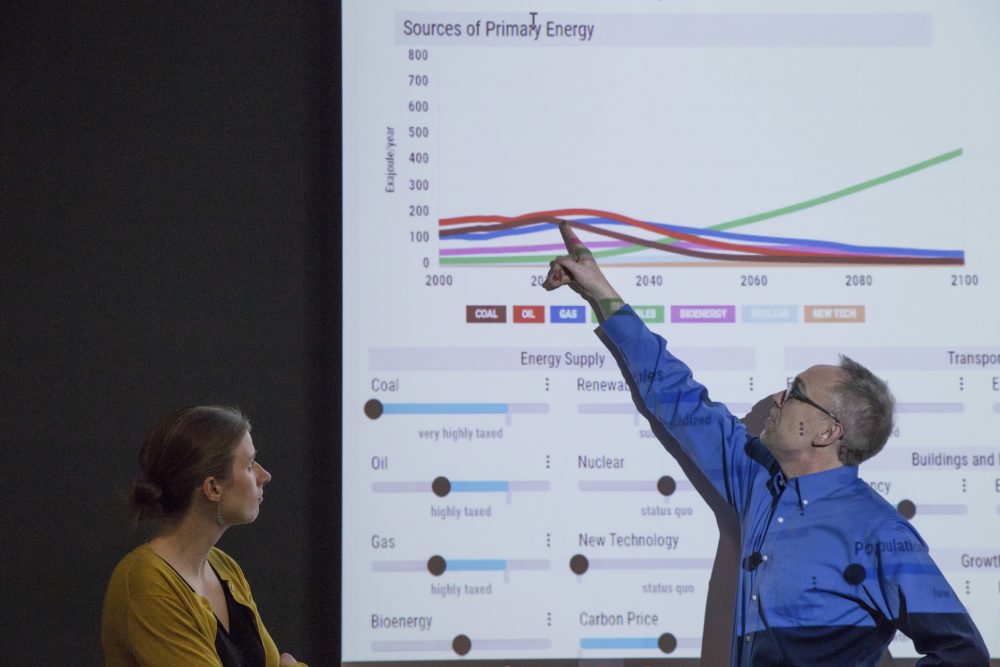
The simulator allows users to use sliders of various metrics to change the data displayed in two graphs: one predicting global sources of primary energy and one greenhouse gas net emissions from the years 2000 to 2100.
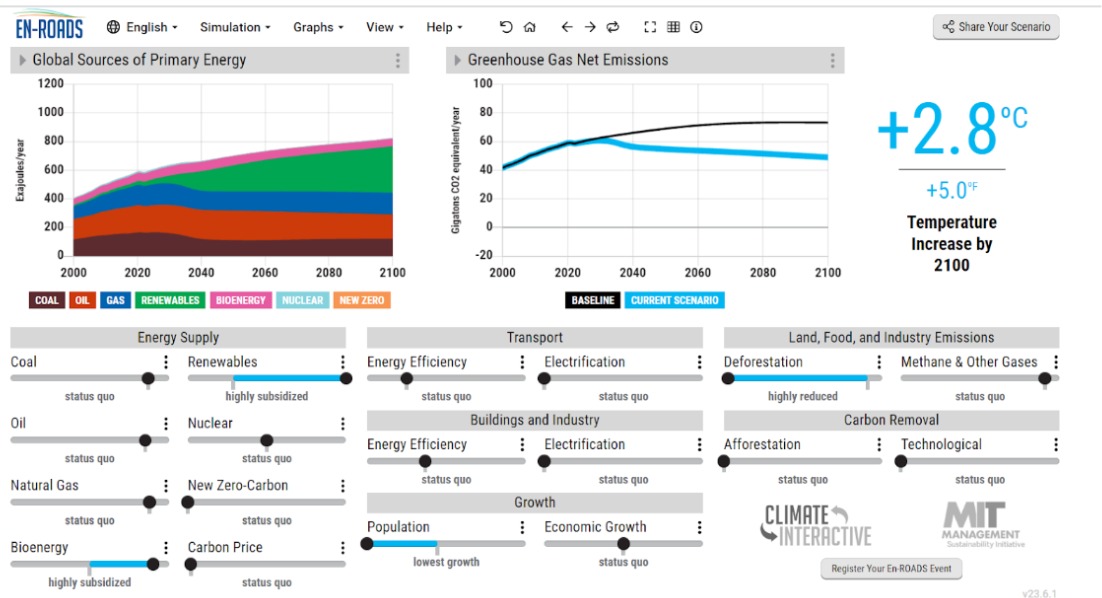
It takes a few minutes of getting used to, but play around with it for a short time and you can see how even small tweaks to metrics such as deforestation, population and renewable energy supply can impact greenhouse gas net emissions. One takeaway is that even by focusing on one metric — take population for example — and dragging the slider down to its lowest possible growth, En-ROAD’s prediction is that global temperature rises will not remain under the 1.5-degree threshold.
According to the simulator, in order for us to reach our 1.5-degree goal and spare the earth from the worst impacts of climate change, enormous changes to all sectors need to take place. This realisation is at once depressing and humbling — however, the clarity with which the data and predictions are displayed makes it crystal clear once and for all what needs to be done.
Final thought
This data is, and has long been, available to us — to policymakers, too. We have long known what the necessary end to our continued pressure on the earth’s resources will be. Scientists have been giving us clear evidence of impending climate catastrophe since the 1980s at least. Therefore the main issue is not that we don’t have the data, or that the data has not, until now, been clear. The issue is that we continue to do nothing about it.
We have enough data. What we need is for policymakers to actually start taking action. What simulators such as En-ROADS have the power to do is to add pressure to governments, and make it easier for the public to see how far we have to go, which in turn has the potential to add more pressure. However, ultimately, how successful climate simulators are, and our fight against climate change as a whole, is in the hands of the people at the top.